

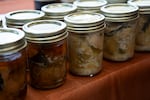
Left to right, Ryan Smith shows the variety of smoked salmon for sale to customer Emily Macdonald at the Black Friday Indigenous market on Nov. 27, 2026 in Portland, Ore. The event is in its ninth year and is hosted by nonprofit Portland Indigenous Marketplace.
Saskia Hatvany / OPB
The air smells like spiced cider and the tangled aromas of fragrant candles. Nearby, a flute sings below the hum of a dozen vendors selling their wares, from carefully propagated plants to chessboards made of resin inlaid with blood orange slices.
Lluvia Merello, the founder and executive director of Portland Indigenous Marketplace, has been working all morning to get set up for the nonprofit’s ninth annual Black Friday market.
Since its inception, the market has grown into a destination for Indigenous entrepreneurs and makers with roots spanning not just the Pacific Northwest but the globe.
“It’s pretty amazing,” Merello, who is Quechua, said. “I was just this morning thinking about that first year and how we just had no idea what to expect.”
The market runs Nov. 27-29 and takes place across two locations in Portland: 624 SE 7th Ave. and Portland State University’s Native American Student and Community Center.
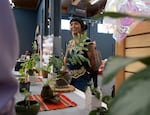
Lupe Rodriguez greets customers at her stand filled with plants.
Saskia Hatvany / OPB
Lupe Rodriguez is Mexica, a descendant of the Nahua people, which makes up the largest Indigenous group in Mexico.
From a distance, Rodriguez’s vendor table looks like it might belong in a plant shop.
Up close, mounted to a wire rack on a strip of bark, is a dark-green ball of clay and soil, wrapped in Spanish moss. Next to it, the coin-like leaves of a Chinese money plant sprout up out of a clay pot.
Rodriguez, who’s sold her plants at the market for five years, said she began propagating plants during a rough season of life.
During that time, she wanted a dog, but her therapist told her to try taking care of a plant for a year — a Chinese money plant, like the one on her table.
“Once I learned about it and learned how to care for it, and learned how easy it will have babies and how quickly you can multiply them, I started doing that,” Rodriguez said.
“I really enjoy that the marketplace has such a consistent community, that I have people that come and buy a plant from me at every market,” she said. “And they show me photos of the plants that they have bought and how much they’ve grown.”


All images: Saskia Hatvany / OPB.
Rodriguez, who also practices Aztec dance, performed at the market with a group of traditional dancers. Clad in vibrant traditional and ceremonial clothing, the dancers fastened rattles to their legs and performed the “danza azteca” in a large circle to the rolling beat of a drum.
Javin Lindoff, who’s from the Kaagwaantaan tribe, was born and raised in Juneau, Alaska, and the nearby village of Hoonah.
He’s a certified tribal artist and has been making dreamcatchers for about 20 years.
When he first started teaching himself how to make them, he’d fashion them out of metal, which he says can be expensive and look too similar to one another.
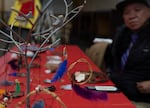
A handmade dreamcatcher hangs at Javin Lindoff's booth.
Saskia Hatvany / OPB
Now, he primarily makes them out of roots and branches, and only adorns them with glass beads, seashells or special gems.
“I like to make every single dreamcatcher unique and different, so nobody has somebody else’s dreamcatcher,” he said.
Lindoff is far from the only vendor who knows the high costs associated with selling handmade goods.
The cost of the materials is one thing. But it’s often steep fees that keep would-be vendors out markets .
Lindoff said larger markets in Portland can charge hundreds of dollars just to set up a table.
He credits Merello with making the Indigenous market more accessible.
“She made it possible and affordable for Native artists and Black artists to be able to show their artwork and not have to pay an arm and a leg just to do it,” he said.

Babaa Maadizi, 4, plays at the market while her mother runs a stand.
Saskia Hatvany / OPB
Portland resident Chris Fredericks, who said he’s part Yupik Eskimo and Athabascan Indian, came out for early Christmas shopping — a popular Black Friday activity usually reserved for big-box retailers.
“Come out and support people, you know, small businesses — especially Native-owned,” Fredericks said. “It’s very important.”
Andrea Urbina, a vendor from Portland, made more than 120 items — from soaking salts to candles to face creams — in just two days.
Now in her fourth year at the market, Urbina, whose grandparents are from the Cherokee and Choctaw nations, said she feels honored to sell her handmade self-care products among the diverse group of makers and business owners.
“All these vendors are very beautiful and unique,” she said. “It is really nice. Everybody here that you see is completely loving, and they’re like family.”
