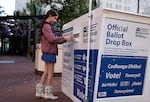
Luna Padilla, 10, drops off her mom’s ballot in a Multnomah County ballot drop box in Pioneer Courthouse Square in downtown Portland, Ore., on May 15, 2026. “I always let her drop it because there’s just teaching the importance of voting and being able to use your voice,” said Padilla’s mother, Brandan M Padilla, who tries to find many ways to show her daughter how to use her voice as a young girl.
Eli Imadali / OPB
Election Day arrives in just four short days, with mail-in voting already underway in Oregon and Washington. The Trump administration is continuing to challenge the country’s ballots, methods of voting and state voter rolls all around the country. Trump is sending federal election observers to Oregon, Washington and a handful of states. In Washington, the state has also been dealing with allegations that the state’s voter rolls are rife with noncitizens.
Washington’s Director of Elections Stuart Holmes joins us to talk about the accuracy and security of the state’s voter rolls and election system more broadly in this political moment. We also get an update from Tim Scott, director of the Multnomah County Elections office, about Election Day observers and recommendations for where and how county residents can cast their ballots.
Note: The following transcript was transcribed digitally and validated for accuracy, readability and formatting by an OPB volunteer.
Dave Miller: This is Think Out Loud on OPB. I’m Dave Miller. Election Day is this coming Tuesday, with mail-in voting already underway in Oregon, Washington and all around the country. The Trump administration is continuing to challenge ballots, methods of voting and state voter rolls nationwide.
Earlier this week, the U.S. Department of Justice sent a letter to Washington’s secretary of state saying that more than 400 noncitizens have been voting in the state. Washington officials pushed back, saying the letter was a “dumpster fire disguised as a legal document rife with mistakes.” And the administration says it’s sending federal election observers to Oregon, Washington and a handful of other states.
In a few minutes we’ll hear from the director of the Multnomah County Elections Office, but we start with Stuart Holmes. He is the director of elections in Washington. Stuart Holmes, welcome to the show.
Stuart Holmes: Good afternoon. Thanks for having me.
Miller: I want to start with this letter that the federal Department of Justice sent to the secretary of state there. My understanding is that there were no voter ID numbers or addresses on the list, and there were some duplicates. But what were you all able to find out in the last couple days about the people on this list?
Holmes: The state of Washington, of course, takes voting fraud very seriously. So we took possession of the list, and we were able to process it and compare it against the voter roll. We were able to identify, in many cases, that the individuals on the list were not actually registered to vote. We also identified instances in which they had provided documentary proof of citizenship with our state agencies. So we found and concluded that the list that was provided by the Department of Justice was simply not sufficient or reliable.
Miller: Last month, The New York Times reported that the administration’s claims of 16,000 noncitizens voting in Nevada turned into 185 people that they then put forward, and then that turned to zero when state officials there actually checked that federal list. At this point, have you found any evidence that the Washingtonians on the list that you got voted illegally?
Holmes: No, there’s no evidence, factual evidence or documentation, that would support that conclusion that anyone on this list is noncitizen. Each of the registered voters … in some cases, they were not registered, right? So in any case, any of the registered voters have attested to their citizenship consistent with federal law. So there is no evidence. We’ve requested that the Department of Justice provide the evidence to support their conclusions, and when we receive that, we’ll happily review it.
Miller: The secretary of state, Steve Hobbs, spoke about this at a press conference yesterday. After that, acting U.S. Attorney Neil Floyd wrote this in a statement. He said, “At his press conference today, Secretary Hobbs said it’s not unusual for noncitizens to be on the rolls. We have never said there are none on there. He also said we don’t have a system that can identify if someone is actually a noncitizen.” In other words, they wrote, “The state of Washington does nothing to confirm citizenship. They are knowingly sending out ballots to noncitizens and trusting that the noncitizens will not fill out the ballot.”
What’s your response?
Holmes: Voter list maintenance is incredibly important. If we receive any information that there is an ineligible voter from the rolls, consistent with federal law that makes that illegal and consistent with our own state laws that direct us to take specific actions, we immediately act to remove any ineligible voter from the rolls and follow all federal and state laws that it relates to that.
Any individuals that are listening, if you are ineligible and you receive a ballot or a voter registration card, immediately contact the secretary of state’s office, and we’ll immediately respond to that in accordance with the laws. And in some cases, in Washington state law, if an individual has been erroneously registered to vote by a state agency, we’ll examine that directly with the state agency for preventing it from happening again.
Miller: It seems like the largest point, the sharpest point that, in this case, the top federal prosecutor in the Seattle area is making is that you’re relying on self-attestation of people saying that they can legally vote, instead of checking to see if they can legally vote, instead of checking to see if they indeed, in this case, are citizens. What’s your direct response to that piece of their argument?
Holmes: So just to be clear, in Washington state, a majority of our registrations come through the Department of Licensing through a program called Motor Voter. In many cases, these individuals are getting an enhanced driver’s license, which means they’ve provided proof of citizenship at the registration counter. But for those registrations that are not providing that or are not getting an enhanced ID, they are doing that attestation process.
The state of Washington and the federal government are on the same page. We want to prevent voters that are not eligible to vote, for citizenship or any other reason, from being registered to vote, and identifying those individuals that are on the rolls erroneously to be removed. The fact is that there is no federal database of citizens. There is the SAVE system that gets touted by the federal administration, but it’s unfortunately shown and proven itself to identify U.S. citizens as noncitizens.
Additionally, there’s no systematic way for our voter registration system to interact with that system. That system either requires you to manually search a database or provide the federal government with a list that you upload into their program. And that’s just simply not safe or secure.
Miller: I want to flip this around. What would it mean if you were to do what the feds are asking you to do and to not count people’s votes if you do not have clear evidence that they should not be allowed to vote?
Holmes: Well, it would be a straightforward violation of their constitutional rights. It would be a violation of both federal and state law. State laws have very clear procedures on how these things can be handled through voter registration challenges. If the Department of Justice has documentation, and they state that they do, they can provide that to the state of Washington. Those will be forwarded down to prosecuting attorneys for their review, and potentially the challenge and removal of that voter’s registration.
Miller: Can you give us a sense for the kinds of scenarios that your team or folks at the various county levels in Washington are talking about right now? I mean, most specifically, I’m wondering what you see as the most likely avenues the administration might take to challenge various results in various counties or states around the country after election day.
Holmes: Yeah, we’re certainly preparing for any and all possibilities when it comes to after election day and the certification of the results. We’re anticipating that there will be potential challenges to the counting of ballots that are postmarked on time but received after Election Day. There was a significant court case related to that earlier this year that was decided by the Supreme Court, but still questions remain on what’ll happen with that.
Additionally, there’s questions being raised recently related to the voting systems that are used around the country that are certified by the Election Assistance Commission in the states to be approved for use in their state. So I think that when it comes down to election procedures, the equipment that is being used, the election officials themselves, all avenues are on the table.
Miller: Stuart Holmes, thanks very much. That’s Stuart Holmes. He’s the director of elections for Washington state.
Tim Scott joins us now. He is the director of Multnomah County Elections. Welcome back to the show.
Tim Scott: Thank you.
Miller: I want to start with the announcement that the U.S. Department of Justice made recently that they’re going to send election observers to Multnomah County. How common is this?
Scott: I’ve been doing this for a long time, 18 years with Multnomah County, and I’m not sure that DOJ monitors have ever come to Multnomah County. It’s entirely possible. I know that I’ve interfaced with congressional observers before. The act of observing itself is very common. We have observers in our building all the time.
Miller: What rules do all election observers, whether they are sent by Senate or House staffers, or in this case federal DOJ, or just regular folks who are curious about one of the most important parts of civic life … What rules does everybody have to follow?
Scott: Because transparency is a value for us, we encourage people to come be an observer for the election. We have a whole web page set up to provide information about what to expect. Included on that website are the observer rules that someone would have to sign in order to come be an observer. And it’s a long list. I’m not going to name them all, but basically, they’re all geared around making sure that we are able to continue processing ballots, continue serving voters without interruption. So, when observers arrive, they are assigned a monitor who will stay with them the entire time.
Miller: Each observer has an observer?
Scott: Initially, someone will escort them into the building. But we have three observation areas, and typically we have one or two observer monitors watching a large group of folks.
Miller: I won’t make you go through all of the rules, but what are the most important ones? And what are you trying to prevent?
Scott: Well, the security of the election and the security of our staff are the most important things. We want to make sure that the ballots are secure and protected the entire time that we’re processing them. So they have to stay where they’re assigned to the observation areas. They can’t wander around the building. They need to stay with the monitors. They can’t interface directly with election workers. They have to ask their questions to the monitors, who will then forward them to senior staff if necessary.
Miller: Back in August, the federal DOJ sent monitors to Wyoming. The Republican governor there, after their primary, called their behavior “aggressive and irregular.” He said, “I feel very strongly about the federal government coming in and taking our guns. I don’t like that. I don’t like the federal government coming in and taking our votes either.” This was in a deep red state. What are you expecting in Oregon?
Scott: Well, I’m an election administrator, and observers and transparency are part of the Oregon vote-by-mail process. And from what’s been communicated to me by the folks at the DOJ that I’ve interfaced with, it sounds like they’re on the same page as we are. Their list of things they will and won’t do align with our list of things that we expect of them.
Miller: Well, let me say one more thing, ask one more thing about Wyoming. The Laramie County Clerk there said that “monitors requested training guides, asked how our new election equipment was acquired, and wanted to examine our tabulators.” Would any of that be allowed in Multnomah County?
Scott: Well, we would ask them to submit a public records request for any documents, and then we would go through the Oregon public records request process. They won’t be allowed in the tabulation room. That is not one of the places that any of the observers get to go, but they can watch through the glass, and whatever they can see through the glass, they can see.
Miller: What has observer turnout been like already so far this cycle?
Scott: We’ve probably had a dozen people cycling through. Some of them are with political parties. Some of them are just individuals who are interested in the process. We also hold tours pretty regularly. We had a group of Girl Scouts come through last week. We want to make sure that people have confidence in the vote-by-mail process. So we try to keep an open-door policy, and anyone who wants to come in can.
Miller: You said about a dozen people so far. Is that about average for the elections, in this case, a midterm election, or is that above or below it?
Scott: For a federal general election, yeah, that’s pretty normal.
Miller: The DOJ did say, in an email last week, that its monitors will dress in business casual clothes with no pins identifying their employer, that they’re federal officials. So would you even know if DOJ officials have been among those dozen? Clearly, they’re not going to be the Girl Scouts, but would you know if they’ve been there already?
Scott: They indicated to me that they were only going to be there on Election Day, so I expect in good faith that they will only be there on Election Day. And they are planning on sending 10 folks to Multnomah County in pairs of two. So five observer pairs, and only one of those groups or one of those pairs is going to be at my building on Election Day.
They’re mainly focused on accessibility and potential instances of voter intimidation. They’ve stated that they’re going to be taking a look at ballot drop sites for accessibility. I’ve asked for a checklist. Usually when you talk about accessibility, there’s a checklist, like what makes it accessible. They said they would provide that in advance of the visit. And I know they’re planning to send a pair of observers to our voting center in Gresham.
Miller: How will you assure that these monitors themselves don’t somehow create their own version of voter intimidation?
Scott: That’s something that any observer could do, right? I have lots of observers who come through the Elections Office. Most of them, when they leave, are pleasantly surprised. They’ve seen a secure, accurate process. But oftentimes people carry into the office with them conspiracy theories that something isn’t happening the way they think it should be or the way they’ve been led to believe it does. And I can’t take responsibility for changing everybody’s mind. So it’s possible people leave with a scenario that just isn’t true. And we would have to deal with that if it came up.
Miller: How would you describe the security of the system as a whole in this election compared to other ones?
Scott: It is exactly as secure as it is every election. Election security is not something that we just started thinking about this election, or in 2020, or in 2016. It’s something we always think about. We always have a detailed security plan for every election. I will say, though, that starting in 2020, we started adding additional protections that we hadn’t considered before we got to such a monumental place in election administration.
Miller: What should people do? Now, this is advice for the procrastinators in our audience, and Multnomah County is overrepresented in that list statewide. What should folks do with their ballots if they have not already mailed them or put them in a drop box?
Scott: I say this every election, multiple times: It’s in your best interest to not wait to vote until election day. It’s also in our best interest. The more ballots we get on Election Day, the longer it takes to process them. That’s nothing new. And if people want timely results, the best thing they can do is vote early. The higher percentage of votes that we have gotten all the way through the processing, when we flip the switch at 8 o’clock and can release the results, the better off everyone is in terms of knowing who won the election. But you can vote right up until 8 o’clock on election night with a drop site. You can go into the post office and get a manual postmark at the counter and turn it over to them, and it will count.
Miller: But if you do that, you’re saying don’t complain to me that we won’t have results for some races until Thursday or Friday?
Scott: Exactly. If we had all the ballots by today, say, for the entire election, we would know exactly the final results by Tuesday.
Miller: Tim, thanks very much.
Scott: Of course. Glad to be here.
Miller: Tim Scott is the director of Multnomah County Elections.
“Think Out Loud®” broadcasts live at noon every day and rebroadcasts at 8 p.m.
If you’d like to comment on any of the topics in this show or suggest a topic of your own, please get in touch with us on Facebook, send an email to thinkoutloud@opb.org, or you can leave a voicemail for us at 503-293-1983.
