
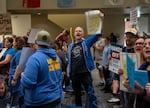
Sam Ellingson, who is the a second grade parent at James John Elementary and the Parent Teacher Association president, chants before a Portland Public Schools board meeting inside the Dr. Matthew Prophet Education Center, Oct. 6, 2026 in Portland, Ore.
Eli Imadali / OPB



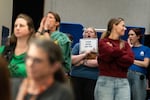
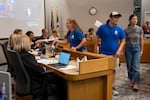
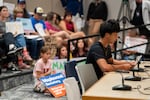

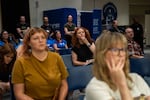


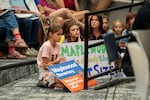





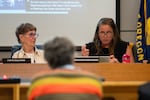
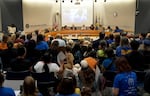






Students, staff, and parents representing over a dozen Portland schools, crowded the Portland Public Schools headquarters building Tuesday to protest newly released plans to “rightsize” the district by closing schools, consolidating programs, and shifting education models.
At a rally before the meeting, Portland Association of Teacher president Alisha Chavez read off each of the schools proposed for closure. The crowd cheered, sometimes for their own schools, but also for others.
Hours later, during the board meeting, some from that same group asked PPS Executive Director of School Planning and Modernization Margaret Calvert to name the schools up for closure. This time, they booed.
It was an example of a dissonance between district officials somberly sharing hard news and a frustrated community rallying against that news.
Released Monday, PPS’ plan offers two scenarios, closing either 11 or 14 school buildings across Oregon’s largest district.
From the proposed closures of Stephenson Elementary School in Portland’s Southwest corner to James John Elementary in North Portland’s St. Johns neighborhood, Portland Public Schools Superintendent Kimberlee Armstrong’s plan would reshape Oregon’s largest school district in an effort to manage the effects of declining enrollment.
“We are sliding down an enrollment hill, and we need to find footing,” Calvert said.
Calvert and two other district officials shared details about the plan with the board at Tuesday’s meeting, such as what percentages of students from certain schools slated for closure might move to different receiving schools.
During the presentation, district officials shared the rationale behind closing certain schools and keeping others open. For example, the district decided to recommend James John in North Portland for closure because Sitton, another elementary school in the area, is more accessible under the Americans with Disabilities Act. Other schools were not closed because they are “more centrally located to families in the region.” Officials also cited enrollment projections that show schools are expected to lose students in five years as factors in closure decisions.
The district’s goal is for the future schools to be “sustainable schools” with large enough enrollments that instructional programs can be run efficiently and equitably across PPS.
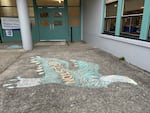
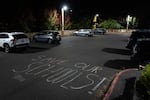
After hearing their school was on both lists of proposed closures from Portland Public Schools on October 5, 2026, a group of Creston parents came together overnight to create chalk art with encouraging messages to greet students and staff in the morning. PTA members collaborated on this rendition of Creston's eagle mascot designed by Jordan Bagnall.
Julie Sabatier / OPB
The district makes the argument that running schools with small enrollments is costly, inefficient and compromises the student experience. The district’s goal is to reduce costs and expand academic offerings by consolidating greater numbers of students into a smaller portfolio of buildings.
But these proposed changes will affect thousands of students. According to the district, 7,981 students in kindergarten through eighth grade would move in Scenario A. Under Scenario B, 6,988 students would be moving under.
The students, families, and staff rallying against the closures questioned the district’s reasoning, and asked the board to push back on the proposals.
Rieke parent and volunteer with the Save PDX Schools coalition Matt Coolidge spoke at the rally before the board meeting.
“We are here today to express our united opposition to a proposal that will displace more than a quarter of our student community, splinter neighborhoods and make Portland a much more difficult place to live and raise our families.”
Later in the rally, Marysville fourth grade teacher Andrew Boehm mentioned the constant shifts schools have been through, including the Southeast Guiding Coalition that led to boundary changes and school moves in 2023. Boehm also mentioned that Marysville received seismic upgrades as part of a taxpayer-funded bond.
To align with the poetry unit he’s teaching students, Boehm read a poem he wrote.
“Communities matter, especially when battered, kids and families will again be displaced - the problem that we must face, is not funding, it’s how to explain this to our future generation that they’re just numbers on a page, moving parts in a never-ending game, where we never have enough,” he recited.
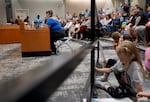
The board meeting started several minutes late after district security stopped letting attendees into the building. Eventually, hundreds continued to file in, filling every seat in the boardroom, with some students sitting on the floor facing the school board.
During the meeting, members of the audience repeatedly interrupted the board meeting, prompting threats from board chair Eddie Wang that they would move the meeting.
Public comment during the meeting also drew complaints about the district’s proposals.
“In January 2026, senior chief of operations Dr. Jon Franco and district facility officials explicitly assured our community that Rose City Park was not a candidate for school closure due to its high priority seismic status,” Oregon Rep. Thuy Tran, D-Portland told the school board over Zoom.
“This flip-flop highlights a pattern of broken promises and lack of transparency.”
Board reaction to the proposals were nearly as strong as the community reaction.
“To me this plan is mayhem,” said board member Stephanie Engelsman. Engelsman expressed several concerns - from the transportation costs of closing schools to the reasoning behind the proposals to the plan to discontinue the environmental focus option at Sunnyside and the arts focus option at Buckman.
Student representative Rose Sandell asked how the district is factoring in student success and sense of belonging as this process continues. District officials said they’ll be monitoring students.
Other board members asked about the fiscal impact of the proposals and how schools would be staffed. And they asked for continued communication and transparency as the decision making process continues.
The board will continue discussing these proposals up until the final vote, scheduled for Dec. 15.
