
Portland Public Schools announced two scenarios Monday evening that would result in massive changes for Portland’s elementary, middle and K-8 schools, including building closures, program consolidations and changes to school boundaries.
Scenario A lists 14 schools slated to close: 13 elementary schools and one middle school. Those schools are: Maplewood, Stephenson, Irvington, Rose City Park, Buckman, Creston, Marysville, Woodmere, Lewis, Beach, James John, Peninsula, Sabin and Sellwood Middle School. Students from those schools would go to different “receiving schools.” This scenario includes 38 boundary changes.
Scenario B lists 11 schools, with similar “reconfigurations” and program moves, but with three fewer schools affected by changes. The schools proposed for closure are the same as Scenario A, except that Stephenson, Rose City Park and Lewis elementaries would remain open. This scenario includes 34 boundary changes.
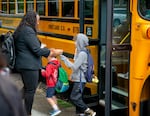
FILE - Portland Public Schools Superintendent Kimberlee Armstrong hands out pens to students at Woodlawn Elementary in northeast Portland, Ore., Aug. 27, 2024.
Anna Lueck / OPB
Under the scenarios, district officials say no dual language immersion programs will be eliminated, but they would be “relocated or combined at designated schools.” The only focus option closing under these scenarios is Buckman, an arts-focused elementary school.
There are changes coming to other PPS schools in both scenarios. Sunnyside K-8 would not close, but its status as an environmental focus option school would be “discontinued.” Odyssey, another focus option school, would move buildings to Metropolitan Learning Center. MLC’s high school would close. Armstrong’s proposals would also shift much of the district away from the K-8 school structure, turning seven K-8 schools into K-5 schools, including Beverly Cleary, Laurelhurst, Sunnyside, Bridger Creative Science, César Chávez, Faubion and Vernon.
Several current K-8s are not listed as changing, including Astor, Skyline and Winterhaven.
A third scenario would be to make no change.
Most recommendations in the scenarios would go into effect in fall 2027. The board is expected to vote on a final plan this December.
“I figure it’ll go three ways,” said PPS Superintendent Kimberlee Armstrong in an interview Friday ahead of the scenarios being published.
“They will choose to accept my recommendation with no changes, they’ll accept my recommendation with maybe some changes, or they’ll choose to defer the conversation about our rightsizing work.”
In a press release Monday evening, the union representing Portland teachers asked the district to take a more “measured and community centered approach.”
“Closing, consolidating, and transforming programs at over 25 schools is a dramatic change,” wrote Portland Association of Teachers president Alisha Chavez. “It’s critical that PPS get the process right, which requires slowing down and involving more stakeholders.”
School principals shared the news with families Monday. “While these proposed changes aim to build a stable, long-term future for our district, I know this news directly touches all of our hearts,” wrote Buckman principal Lisa Ditto.
Gary Gregoricka, principal at Irvington Elementary, stressed in a message to families that no decision has been made yet.
“If the district is moving forward with the change, the Beverly Cleary administration and I will work with both communities on a transition plan that ensures that we are supporting all students, staff, and families in this move,” Gregoricka said.
What’s behind the decision
Earlier this year, PPS hosted sessions to hear from families and community members about schools. Through those conversations, PPS officials say they heard from students and families who loved their neighborhood schools, which offer community, bike buses and dual language immersion programs. PPS officials also heard from families and students in support of focus options, like art at Buckman and da Vinci and environmental issues at Sunnyside, which draw students from across the district.
But Armstrong said the district’s decision wasn’t about saying one version of school is better than the other.
“Our goal in this was never to get into a situation where we’re pitting communities against each other or standing behind one specific model,” Armstrong said.
Factors in the district’s decisions included a school’s enrollment and capacity, as well as the physical conditions of a school. Does it comply with the Americans with Disabilities Act? Are the mechanical systems up to date?
“We also looked at schools that have the capacity to support childcare programming,” Armstrong said. She said a school’s walkability was also a consideration.
As a district, PPS faces another large budget deficit again this year: a $65 million budget hole for next school year, assuming a consistent funding level from the state. Armstrong said the decision to close schools is not about the district’s multi-million-dollar budget challenges, but about making sure every school in Portland can offer a standard of service to its students. Right now, she says that’s not the case.
“We’re closing schools because we’re spreading our resources too thin,” Armstrong said. “We’re subsidizing … we’re taking from one and adding to another with the budget that we currently have.”
Portland parents and staff members are already pushing back on this plan.
“‘Rightsizing’ is wrong for Portland,” reads the main page of savepdxschools.org, a group of parents organizing against the district’s “rightsizing” plan. Two different petitions backed by families and teachers ask the district to take steps before making big changes, suggesting the district first look to redraw boundaries and reduce staffing at the district office. One petition presents a list of questions for the school board to ask ahead of voting on any proposal.
PPS is far from the only school district closing schools. Marguerite Roza of Georgetown University’s Edunomics Lab calls it the “big shrink”. Birth rates are falling, families are choosing alternatives for their children’s education and too few students are enrolling in public schools to run them efficiently. In July, the Washington Post reported that the number of schools closing in the US is up 35% over the last four years.
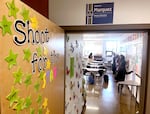
FILE - Students work in a math class at McKay High School, part of the Salem-Keizer district, in Salem, Ore., on Sept. 13, 2023.
Natalie Pate / OPB
Salem-Keizer, another of Oregon’s largest districts, has announced plans to close “up to eight” elementary schools. In Southwest Washington, Evergreen is considering school closures, too. Across the country, districts from Cleveland to Austin are closing schools due to declining enrollment. In Seattle, district officials spent months talking about school closures, only to announce a plan to close four schools and then drop the plan one month later.
What’s next

Sabin Elementary School, pictured on Oct. 5, 2026, in Northeast Portland.
Rob Manning / OPB
Going forward, Armstrong said the district’s community engagement plan will include a focus on comments and concerns, all shared on the district’s “rightsizing” webpage.
She said the district will have to “wait to see” whether families leave the district as a result of these changes. Families have that choice, she said.
“The question that I hold onto, though, is what happens if we do nothing? Some of the families that are saying they’re leaving, it’s like, ‘Well, if you make this change, we’ll leave.’ Well, if we don’t make the change, then how will we continue to be able to support at the level we need to?”
Armstrong said the scenarios can only project the district’s stability for the next five years, to the 2031-32 school year. After that, it’s unknown if the district may have to close more schools to further manage declining enrollment.
PPS officials will share more information about these closures with the school board and the broader district community at its regular school board meeting Tuesday evening. Families are already planning a rally in advance of the meeting to protest the district’s efforts and “protect our public schools.”
Board member Virginia La Forte posted a video Friday, acknowledging the anxiety around this decision and conversation.
“It’s weighing heavy on all of us,” La Forte said. “We understand the value of our schools in our neighborhoods and for our city … please stay engaged, give us feedback, and we’ll see you Tuesday.”
While the district has prepared the proposals that will be presented to the school board Tuesday evening, it’s up to the school board to vote on the final decision. That’s expected in December.
Related: Read: Portland Public Schools "right-sizing" scenarios
