
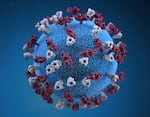
This illustration provides a 3D graphic representation of a spherical measles virus particle that is studded with glycoprotein tubercles. Those tubercular studs, colorized maroon, are known as H-proteins (hemagglutinin), while those colorized gray represent what are referred to as F-proteins (fusion). The F-protein is responsible for fusion of the virus and host cell membranes, viral penetration and hemolysis. The H-protein is responsible for the binding of virions to cells. Both types of proteinaceous studs are embedded in the particle envelope’s lipid bilayer.
Provided by Allison M. Maiuri, MPH, CHES / Centers for Disease Control and Prevention
Health officials in Oregon anticipate a very active season for respiratory viruses during the remainder of the year and are urging people to prepare by getting vaccinated.
Those illnesses include influenza, COVID-19, respiratory syncytial virus (RSV) and measles, all of which have vaccines available for this year.
Last winter was a moderately severe flu season in Oregon, health officials said, and they expect the upcoming season to be similar. The state also saw a surge in COVID-19 cases this summer.
Dr. Dean Sidelinger, the state’s health officer and epidemiologist for the Oregon Health Authority, said diseases like flu or RSV can be particularly dangerous for vulnerable populations: young children, the elderly and those with weakened immune systems.
“The (Centers for Disease Control and Prevention) is predicting a similarly severe flu season this year, and we’re already seeing an increase in positive flu tests in recent weeks,” Sidelinger said.
Further complicating the picture has been the resurgence of measles. A disease once declared eliminated in the U.S., it has resurfaced due to waning vaccination rates among children.
The Oregon Health Authority has reported 58 measles cases across the state so far this year. That’s the highest yearly total for Oregon since 1991. Sidelinger said that number is likely higher.
“We still continue to see measles detected in the wastewater, and sometimes those detections happen in counties where we haven’t had a reported case,” he said.
Measles is easily preventable with a vaccine, but there is no antiviral treatment for it. Children, pregnant people and others with weakened immune systems are at particular risk for complications and hospitalization.
Vaccines for all these respiratory illnesses are available either free or at low cost for many Oregonians, officials said.
Public health officials also said they have to frequently combat misinformation and misunderstandings about vaccines and their impacts. Sidelinger said many families still have concerns that certain vaccines can cause autism. The overwhelming majority of health officials agree there is no link between vaccines and autism, but the belief has garnered increased support inside the federal government.
“That still continues to come up in people’s social media feeds,” he said. “They hear it from the Secretary of Health and Human Services (Robert F. Kennedy, Jr.), and so people are still concerned about that.”
Dr. Leona O’Keefe, medical director of clinical services at Jackson Care Connect in Medford, also said talking with a healthcare provider can often alleviate some of the concerns that families have about vaccines.
“Having those conversations and remembering that the risk of the disease is far greater than the risk of the vaccine is often quite helpful,” O’Keefe said.
