

Cars drive on Interstate 5 through the Rose Quarter and on the I-5 southbound ramp to Interstate 84, at left, in Portland, Ore., on Aug. 27, 2026. Parts of the I-5 going southbound, including these two sections, will be temporarily closed in September for up to five weeks to repair the aging roadway surface.
Eli Imadali / OPB
Starting late Friday night, all southbound lanes of I-5 through Portland’s Rose Quarter will be closed for five weeks, expanding traffic for commuters and commercial vehicles traveling near one of the city’s major transportation arteries.
The Oregon Department of Transportation is using the all-day closures to repair a 2-mile stretch of the highway, replacing the road’s concrete surface for the first time since 1985. It’s also retrofitting the highway south of the Moda Center to be earthquake ready.
The looming closures are already challenging local businesses as they prepare for what ODOT spokesperson Rose Gerber called “some of the worst traffic this region has seen in some time.”
Here are four things to know ahead of the closures.

What’s closed, and what’s open?
All southbound lanes of I-5 between I-405 and I-84 will be closed, as well as multiple on and off ramps, including:
- Onramp from Alberta Street to I-5 SB
- Onramp from I-405 NB to I-5 SB
- Onramp from Greeley Avenue to I-5 SB
- Onramp from Wheeler/Williams/Ramsay at the Moda Center to I-5 SB
- Offramp from I-5 SB to I-84 EB
- Offramp from I-5 SB to Morrison Bridge
All of I-5 north will remain open during the closures.
Drivers can still travel south through downtown Portland on I-405, and travelers passing through the city can reroute to I-205, which runs through east Portland and parallel to I-5.
The following ramps will remain open:
- Onramp from Rosa Parks Way to I-5 SB
- Onramp from Going Street to I-5 SB
- Offramp from I-5 SB to Broadway
- Onramp from I-84 WB to I-5 SB
- Offramp from I-84 WB to Morrison Bridge
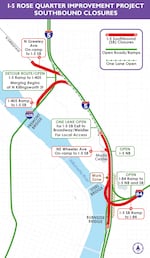

First image: Courtesy of the Oregon Department of Transportation. Second image: Courtesy of ODOT.
How long will commutes be?
Commute times could double, or even triple, in areas near the construction site. That means rush hour traffic in the morning could start as early as 6:30 a.m., and evening traffic could last until 8 p.m.
But how bad traffic gets will partially depend on how drivers change (or don’t change) their behavior.
If you live close to your job, walking, biking or using public transit could help keep cars off the road and reduce congestion, and Portlanders who have the ability to work from home might do so more often.
Taking alternate routes could also mitigate traffic on the 2-mile stretch of I-5. However, detours will also likely push more cars onto other highways and local roads, creating more traffic in nearby neighborhoods.
How can drivers avoid traffic?
Officials at TriMet have encouraged drivers to opt for public transit, which could help commuters avoid congested areas.
However, that will depend on whether they take the bus or the train. TriMet buses could be delayed on some city streets, while MAX light rail trains will avoid much of the expected traffic. TriMet is encouraging riders to plan their trip on the agency’s website.
Gerber said ODOT is encouraging people to plan ahead and to consider other forms of transportation, like walking, biking or carpooling, which would help keep cars off the roads and ease congestion.
The City of Portland has also set up a webpage with resources for commuters looking for ways to beat traffic.
For example, during the closures, the Portland City Bike Bus will meet weekly on the North University Park and Northeast Cully routes. Multiple neighborhoods also have their own bike buses people can join for their commutes.
Remote work would allow some commuters to stay off the affected roads entirely.
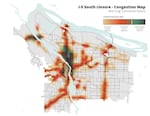
This acquired graphic shows how congested different areas of Portland might become when all southbound lanes of I-5 close for five weeks beginning late in the evening on Sept. 11, 2026. The closure will allow construction crews to make repairs and improvements to a 2-mile stretch of the highway.
Courtesy of the Portland Bureau of Transportation
How long will the closures last?
The closures are expected to last about five weeks, but weather conditions could draw them out longer. For example, rain could hamper construction activities like pouring concrete, striping roads and laying tarmac.
“With closures like this, there’s always the possibility that an unexpected disruption could happen,” Gerber said.
According to Gerber, the five-week closure plan was the fastest of those the agency considered and saves about $9 million compared to the alternatives.
ODOT’s Interim Director Chris Warner said keeping one lane open would have pushed the closures out to four months, and restricting construction to weekends would have stretched the project out to two summers.