
Oregon’s largest school district has lost 6,086 students since 2018. By 2031, they’re projected to lose 3,446 more students. Portland Public Schools’ 81 schools aren’t uniformly losing the same number of students, resulting in some buildings with steep declines in student numbers with others less affected.
The district’s solution to this enrollment problem is to “rightsize” its school campuses through closures.
“Our reality is that we have fewer students in our schools across the city while we have maintained the same number of schools,” said Margaret Calvert, the district’s executive director of school planning and modernization.
“This has been going on for at least the last eight years.”
PPS officials said at a board meeting Tuesday night that shuttering up to 15 elementary schools and three middle schools will address this years-in-the-making program imbalance.
“We have a smaller set of resources and we’re spreading them across the same number of school sites, so it means, by default, that school sites are getting less than they have,” Calvert said.
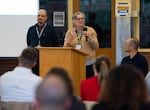
FILE - Margaret Calvert of Portland Public Schools speaks to an audience at Ida B. Wells High School in Portland, Ore., during a meeting to discuss how to “rightsize” the district's schools, on April 22, 2026. PPS plans to close up to 20 schools by the 2027-2028 school year.
Eli Imadali / OPB
As PPS continues to plan for drastic changes to the district, officials say closing schools will standardize the educational experience for all students. In a presentation at Tuesday’s meeting, officials said the goal is to equalize offerings across Portland, so that no matter what school a student attends, they’ll have the same access to arts, counseling and electives.
The district has not named which schools are up for closure, but said factors including enrollment, boundaries, and building condition will be taken into consideration. Though the district continues to deal with million-dollar budget gaps, research has found that closing schools doesn’t save much money.
Board members also raised questions about the ideal size of schools. According to the district’s presentation, an elementary school with 360 students and a middle school of 500 or more is ideal for providing “stability” in staffing and resources.
The number of schools the district has mentioned closing has been a moving target recently. Superintendent Kimberlee Armstrong told reporters last month the district plans to close “up to 20” schools. That’s a jump from the between five and 12 range mentioned at community meetings last spring. The district’s rightsizing website mentions no number at all.
“I worry that a ‘hammer’ approach, where we’re closing a quarter of our schools in the name of big schools just strikes me as possibly doing more damage than we’re meaning to,” said board member Christy Splitt. “So count me in as being more skeptical now than I was a week ago.”
Supt. Armstrong asked the board for more “direction” as the work moves forward. At the same time, she emphasized benefits of consolidation, such as possibly reducing blended, multi-grade classrooms and teachers and other staff spreading their time across multiple schools.
“In order to make change that’s sustainable for at least five years… this is the magnitude of the impact that we would have to take,” Armstrong said.
“I’m just trying to match the energy of the board and want direction on how much further we go with magnitude, or if we need to pivot and reconsider something different.”
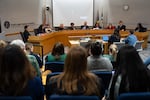
FILE - The Portland Public Schools Board of Education holds a meeting announcing the district’s 2026-2027 budget at Dr. Matthew Prophet Education Center in Portland, Ore., on April 28, 2026.
Eli Imadali / OPB
Portland is far from the only Oregon district closing schools. Beaverton closed a school this year. West Linn-Wilsonville’s board voted to close two, as did Corvallis. In July, Salem-Keizer announced a plan to close up to eight elementary schools. Nationally, the list of cities with school closures includes Cleveland and Austin.
But reality doesn’t make the pain of closing schools any easier.
Eight of the public comments at Tuesday’s meeting came from PPS parents who asked the district to spare their school. Rosy Boyer, who has an eighth grader at Harriet Tubman Middle School, spoke about her son’s elementary, Dr. Martin Luther King Jr., and the district’s historic lack of investment in Northeast Portland.
“If we look only at King’s enrollment without asking why its boundary is so small, we risk allowing past inequities to shape the next round of decisions too,” said Boyer, who asked the district to make sure they’re hearing from all school communities, not just the loudest or wealthiest.
FILE - The third meeting in a series to discuss how to “rightsize” Portland Public Schools takes place at Ida B Wells High School in Portland, Ore., on April 22, 2026. PPS plans to close up to 20 schools by the 2027-2028 school year.
Eli Imadali / OPB
Comments from Rieke Elementary School and Winterhaven K-8 parents illustrated the no-win situation ahead of administrators: to build up neighborhood schools like Rieke, or to lean into focus option schools like Winterhaven, where families enter a lottery to attend. Several parents pressed the district to recruit students who live in Portland but may have left PPS.
“We are not asking PPS to ignore its financial realities, we are asking the district to make decisions based on complete data and to protect programs that families actively choose,” said Sam Bullick, a Winterhaven parent.
Over the next two weeks, the district will host community engagement sessions for specific groups. In addition, Armstrong says she’ll visit 40 of the district’s schools to hear from staff by the end of this year, with a plan to visit the remainder of schools in the new year.
The next school board meeting is Sept. 15. Supt. Armstrong is expected to present her recommendation for school closures later this fall.
