
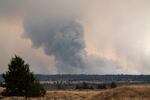
The Bench Fire is seen from Highway 26 near Warm Springs, Ore., on July 30, 2026.
Saskia Hatvany / OPB
Oregon’s wildfires have now burned an estimated 1.8 million acres so far. Dozens of large fires are continuing to burn, many only partially contained.
The Confederated Tribes of the Warm Springs reservation in North Central Oregon is at risk from the Bench fire in the area. The KWSO radio station located inside the reservation is playing a critical role in helping the community stay informed about fire risks and evacuation orders.
KWSO Station Manager Sue Matters joins us with the latest.
Note: The following transcript was transcribed using AI and validated for accuracy, readability and formatting by an OPB volunteer.
Dave Miller: This is Think Out Loud on OPB. I’m Dave Miller. We start today with the Bench Fire, which has burned more than 64,000 acres in Central Oregon, and as of the most recent update, was only 22% contained. The fire is burning in and around the Confederated Tribes of the Warm Springs Reservation. For 40 years, the public radio station KWSO has played a critical role in informing people about what’s happening in the tribal community. That’s especially true today.
Sue Matters is a KWSO station manager. She joins us now. Sue, welcome back to the show.
Sue Matters: Happy to be here.
Miller: What stood out to you in the fire update meeting that you covered last night?
Matters: It was interesting. They had members of the two incident management teams, the Oregon State Fire Marshal – I think they’re the red team – and the Southwest Area Complex team four, plus tribal officials and folks who work in our fire management and public safety. So it was really a great overview of what has occurred. There were 12 lightning strikes and 11 of them started fires. So we maybe didn’t even get as much lightning as some other people in our neighborhood, but they were significant strikes. They got the first call, and in like three minutes, it had already spread 5 acres.
The conditions, I guess, were just ripe for a lightning strike to start a fire, and not just here but throughout Central Oregon. So that was kind of an interesting background. And then there was talk about the drought conditions, the low snowpack and how it’s just not a good time to be having wildfires in Oregon. So that was really interesting. And then just some nitty gritty about the whole incident command structure, the number of teams that came in and how there’s such demand for resources on a national level that it took a while to get the help that was needed for this really quick-spreading fire, but the help came once the Conflagration Act was signed, I guess. So more resources came and then there was air support.
I think, at one point, this fire was like number three in the nation for priority. I think we’ve gone down already, thankfully. I know you mentioned 22% containment at the top of the show, but this morning’s report is that it’s at 32% containment so progress is being made, and that’s a good thing.
The other thing they talked about at the public meeting last night was just that we’ve been very fortunate, no lives have been lost. There have been some structures lost, but the firefighters are working hard, they’re working around the clock, there’s a lot of them – like 800 firefighters. And they’re getting the job done. It’s just that it’s a slow process because Mother Nature is sort of in control.
Miller: When we talked with the secretary-treasurer of the Tribe earlier this week, he said that the boil water and water conservation notices that had gone out already were a kind of preventative measure, but now it seems that the conservation notice is necessary. Can you describe what’s happening right now with the water supply?
Matters: I think this is for the agency water system, so it’s sort of like the population center of Warm Springs. There was a fire, so people were watering their lawns and there was a high water use. The reservoir tanks in a couple of the subdivisions, especially, are at higher elevations so that water can flow with gravity – it takes hydraulic pumps to fill those tanks, and they just weren’t able to keep up with demand over time. So the levels in those two particular areas, but in general, were just low. The water conservation notice came out because people needed to lay off watering their lawns and filling their swimming pools. So that’s ultimately, hopefully, something that can be fixed with some more robust pumps or something, but that’s not really my wheelhouse.
Miller: And there’s been reporting about a leak as well, which makes it even more challenging. We also heard from the secretary-treasurer/CEO about the challenges of getting information out to members of the Tribe because of the loss of power and internet. Has that affected you as a station?
Matters: Well, I think terrestrial radio is still something that is in use in America today, especially in rural places, and where maybe folks who have a little less resources to be hooked to the internet and that kind of thing. So what we’ve learned in the past year, [as] we were sort of assessing how information is shared in Warm Springs, is you really have to do everything. You have to put up the big board, the big plywood board with the fire map every morning with the updated details, and you’ve got to be on the radio, you gotta be on Facebook. We’ve been using our website to post updates about things because not everybody’s on Facebook, and then just be aware that word of mouth is still a powerful thing.
So it’s critical to get good information out to people, because if they don’t have accurate information, they often kind of freestyle and it doesn’t always end up being useful information for people, especially in a high-stress time when there’s danger and people are scared.
Miller: What are people asking for from you in terms of information?
Matters: I think it’s kind of the basic stuff. Here in Warm Springs, a lot of people have done wildland firefighting or have relatives that have. So there’s a little bit more understanding maybe of what a fire management team does and the logistics of fighting fires. I think details about what’s happening out there on the landscape, battling the wildfire, where the fire is, people are very interested in all that, but also, that information [needs to be] delivered in layman’s terms, so people understand.
So that’s kind of been the interest, I think, to just be as plain spoken about giving these updates as we possibly can but including a lot of the information – where there’s resources available and that kind of thing – for people who’ve been impacted.
Miller: Sue, thanks very much. Best of luck to you.
Matters: Thank you so much.
Miller: Sue Matters is a KWSO station manager on the Warm Springs Reservation.
“Think Out Loud®” broadcasts live at noon every day and rebroadcasts at 8 p.m.
If you’d like to comment on any of the topics in this show or suggest a topic of your own, please get in touch with us on Facebook, send an email to thinkoutloud@opb.org, or you can leave a voicemail for us at 503-293-1983.
