
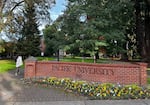
FILE - Pacific University is the second institution in Oregon to announce a move toward three-year bachelor degrees. A student walks on the Pacific campus on October 11, 2024.
Tiffany Camhi / OPB
Pacific University is the latest higher education institution in Oregon to enter the three-year bachelor’s degree frontier.
Pacific, based in Forest Grove, announced Tuesday morning that it will begin offering shortened degrees in a handful of programs — chemistry, computer science and sustainability & adaptation — to new undergraduate students starting in Fall 2027.
University leaders say the new degrees will take three-quarters of the time to complete compared to a traditional four-year bachelor’s. The fast-tracked degrees also boast a 25% discount.
“It’s not a bait and switch at all,” said Brian Jackson, an associate dean at Pacific’s College of Undergraduate Studies. He helped lead the university’s move towards three-year degrees.
Pacific’s estimated undergraduate sticker price for the upcoming school year, or total cost to attend not including financial aid, institutional assistance or scholarships, lands just under $80,000 a year.
“We’ve trimmed our traditional bachelor’s degree,” he said. “Students still participate in our full core curriculum but we’ve taken out the remaining elective credits.”
Pacific’s three-year degree programs will consist of 96 credits, pared down from 124. The Northwest Commission on Colleges and Universities approved the university’s plan, as well as the three accelerated programs that will launch next year.
University leaders say this type of degree is really geared toward students who are career-focused on day one of stepping on campus.
“We have a number of students coming to college with a real purpose and plan in place,” he said. “They know where they’re going and they’d like to get on that path and pursue that direction.”
Pacific is not the first institution in Oregon to launch a three-year degree model. But it is the first to offer these degrees to students who attend classes in person.
In May, George Fox University announced it plans to offer the quicker bachelor’s degrees to students enrolled in its online platform this year. The private, Christian university said its program is targeted primarily toward adult learners.
Other universities in Oregon could soon follow George Fox and Pacific.
“Pacific University’s announcement reflects the spirit of innovation across Oregon’s private, nonprofit colleges and universities as institutions explore new ways to serve today’s students,” said Oregon Alliance of Independent Colleges & Universities President Brent Wilder in a statement. “A three-year bachelor’s degree is one example of how colleges and universities can expand access, increase flexibility, and create additional pathways to a high-quality education.”
More schools across the nation are beginning to dabble in the three-year degree option.
Supporters say it could be a solution to higher education’s affordability problem, as students face rising tuition costs and mounting debt loads each year. Employers like the quicker path to the workforce pipeline. And it could help attract more students to enroll in college at all, helping institutions’ bottom line.
But those against the three-year degree argue it devalues the traditional liberal arts education.
In a joint statement released last month by the American Association of University Professors and the American Federation of Teachers, AAUP president Todd Wolfson and AFT president Randi Weingarten wrote, “Compressing or reducing the curriculum threatens to narrow students’ education at precisely the moment when society needs graduates with stronger critical thinking, communication skills, scientific literacy, and civic understanding.”
University leaders at Pacific think the three-year degree won’t erode its college experience. Even in the three academic areas where three-year degrees are available, Pacific still provides paths to the traditional four-year degree if a student prefers that.
Overall, Pacific leaders say this move to degree completion in three years aligns with the institution’s mission of providing quality education opportunities to more students.
“We are providing the opportunity for students to pursue their purpose with a more accelerated and concentrated degree,” said Jackson. “For students who know what they want, we are making that pursuit more affordable and preparing them to [reach] their goals one year earlier.”
The impending merger of Pacific with Willamette University should not impact the new three-year program, according to a Pacific spokesperson.
