
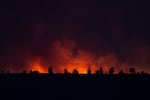
The Bench Fire burns on the Warm Springs Reservation, seen from Culver, Ore., on July 27, 2026.
Eli Imadali / OPB
By Monday, the Bench Fire near the Confederated Tribes of Warm Springs Indian Reservation grew to more than 40,000 acres after combining with the Beachcomb Fire.
At least six homes and five buildings have been lost, according to state fire officials.
Hundreds of people are under Level 3 “Go Now!” evacuation orders, with more than a thousand others under lower evacuation levels.
Confederated Tribes of Warm Springs Tribal Council Chair Dennis White III has issued a state of emergency declaration that authorizes coordination with — and seeks assistance from — state, local and federal agencies to fight the wildfires threatening the reservation and taking a toll on tribal services.
Tribal officials have now issued a water conservation order and a boil water advisory while announcing the closure of government offices on Tuesday.
Edward Henderson, secretary-treasurer and CEO of the Confederated Tribes of Warm Springs, joins us to share more.
Note: The following transcript was transcribed using AI and validated for accuracy, readability and formatting by an OPB volunteer.
Dave Miller: From the Gert Boyle Studio at OPB, this is Think Out Loud. I’m Dave Miller. We turn now to the Bench Fire just west of Madras. It’s burned more than 40,000 acres and is still 0% contained. It’s led to Level 3 “Go Now!” evacuation orders for hundreds of people on the Warm Springs Reservation. More than 1,000 others are under lower evacuation levels. Tribal officials have now issued a water conservation order and a boil water advisory, while announcing the closure of government offices today.
Edward Henderson is the secretary-treasurer and CEO of the Confederated Tribes of the Warm Springs Indian Reservation. He joins us now. Thanks very much for making time for us.
Edward Henderson: Thank you for having me. I look forward to having this dialogue.
Miller: What’s the latest that you’ve heard about the status of the Bench Fire?
Henderson: As of right now, last night we had a 6 p.m. meeting, transferring the fire management piece of it from a smaller crew of 30 to a larger management crew of 90 personnel with expanded capabilities, operational capabilities and other things that go along with that. So currently, we are in the middle of transitioning that.
With the combining of the Bench Fire and the Beachcomb Fire – now, they call it just the Bench Fire – its current acres is at 45,119 acres. That being said, I wanted to quickly catch up on the evacuation. I know you said hundreds, but right now we’re counting at 3,845 evacuated, 6,144 sheltering in place and 40 in temporary shelters. I just want to make sure those numbers are out there. It is larger than what people would think.
Miller: So how much of the Reservation is under a Level 3 “Go Now!” orders?
Henderson: We have three primary areas of residence. We have the North End, the Middle Agency, and then the South End Seekseequa. The latter two, Seekseequa and Agency, are both completely under Level 3.
Miller: Over the weekend, OPB heard from one couple who said they couldn’t evacuate. That they got Level 3 “Go Now!” orders, but the road that they would have taken was closed going in both directions, so they had no choice but to hunker down. They were OK, but what are the challenges when so many people had to leave at the same time?
Henderson: That was a very eye-awakening experience. Even the firefighters who are there, the fire management people are here are out of Arizona, even in their updates, they were really amazed by the winds and the changes. The fire would go away and all of a sudden, within a matter of 15 to 20 minutes, the breeze would change and shift, and the fire would take a 90 degree, and move quickly and stop slowly. So the fire’s behavior has been erratic all over the place, to the point that seasoned firefighters were like “this is really unprecedented” on how this fire is acting.
So when we did the evacuation notice, we thought [evacuees] could roll out on Highway 26 and get to Madras. But within the time it was called to the time that people started moving – you’re talking within a 30-minute span – the fire breached, jumped across the river and threatened the major highway, which obviously made ODOT close that road. So then you have people trapped on the road. You need to bring them back. Shelter-In-Place orders have to happen. It was very demanding because we do not have a very large structural fire capability. So that was a nail-biting time, I would say.
Miller: Where have the people who have evacuated gone?
Henderson: Now, with the shelter-in-place, obviously, 6,144 is a pretty large number. Those on the outer rim of the community, those are coming into the [shelter.] We have, here on the Reservation itself in the Agency area, what they locally call the old grade school cafeteria. So we have cots available there and they have a dining facility in there. Then across the way is the old gymnasium that has been remodeled since, and they use that also as a sleeping area.
Then if you’re an older person, we still have the High Lookee Lodge, which is an adult facility.
Also, we have local churches and stuff who also have residents who they take in. If you’re a senior, you can’t sleep on a cot. Your health prohibits it. So definitely doors have been opened all throughout, to take people in.
Miller: How many buildings at this point have been damaged by the combined fire?
Henderson: A quick rundown. So the private residences have been threatened so far have been 41, two commercial structures were threatened. But of those, six residences were lost and five minor structures, like sheds and workshops, were lost.
Miller: What happens if, on the Reservation, a home is damaged or lost to fire? I’m wondering if that’s different than on non-reservation, non-tribal land?
Henderson: Tribes have a really hard time right now. I believe we’re around 600+ homes short of what we need to house everybody. So you have multi-generational people living in one home. So [with] one structure loss, you’re looking at up to three generations of family members who now are displaced. It’s very impactful when we lose homes here. The way forward is something that we’ve been working on, trying to work with the feds and state. The state has actually come up with some creative ideas that we’re exploring, helping us build homes, whether it’s on reservation or off.
Miller: Can you tell us about the boil water and water conservation advisories that the tribal government issued yesterday?
Henderson: On the boil water notice and the actual conservation of the water, we’re trying to get ahead of it. Not being reactive, but more proactive on things. So when the community itself was threatened directly, a lot of people put out their sprinklers. Prior to that, we had all our tanks at 100%. But people running sprinklers on every hose out there, we really put a drain on it. I think we’re still at a reasonable amount, but we just wanted to get out there and let people know that you’ve got to conserve the water. You got to drink it and everything.
Same with the boil-water notice. As you know, when there’s an emergency, communication is one of those things that is precious. It’s hard to keep active, factual information flowing both ways. So we wanted to get out there in front of the water [issue]. If there’s a boil water notice, they’re going to get caught flat-footed if they’re not able to hear that there is one. So a lot of this is precautionary.
Miller: In other words, in case the water quality or water quality systems fail in the coming days, and communication fails at the same time, you didn’t want to not be able to tell people that, so you’re telling people that now?
Henderson: Correct. So then there’s no risk to health. Again, the protection of property and health of the people, the members, is paramount in what we’re trying to do here. So [it’s] one more step on having safe drinking water versus not being able to get the information out if communication gets cut somehow. We were actually having a lot of problems early on because, as you know, the fire sweeps through, transmission lines have to be de-energized. We had that happen and were without power a couple of times.
So when we lose power here, we don’t have a lot of communication redundancies. The internet all goes down, a lot of things go down. So then it’s by runner. Someone has to go out and tell people or go do things. Then, again, we’re talking about a police department of eight personnel. You can only work them so long and we’ve been going since last week. So the more we can get preemptive on things, the better off we’ll be in the long run.
Miller: I mentioned the boil water and water conservation advisories. What can you still offer? What are you still offering in terms of services as a tribal government, given the closures and given the fire?
Henderson: We’re still offering all sorts of services. Some things may take a little longer. I know that since we don’t have any health care facility – it is closed down because of the Level 3 – you can’t bring people into an area that’s that dangerous. We’ve been having to take them all the way to Madras now via ambulance. And that’s if we have an emergency. So a lot of things are still here. It’s just that things take a little longer. Yeah, that’s kind of where we’re at.
Miller: What are you and other tribal government officials focusing on in the coming days?
Henderson: Coordinating, a lot of coordinating. We still have fires, an active fire, 0% containment, and currently the weather has somewhat been going our way. But that can change very quickly because we still have a lot of fuel out there. Once we get the people taken care of, we have to look at the government itself and the tribe itself. The dams, the tribe owners of the dams, that’s revenue generation and there still could be some threat with that. The fire is still expanding to the west.
Obviously, we’re a timber producing reservation. That’s a resource that, if it was to be all burned up and gone, it would take a real big dent out of the tribal government revenue, because we’re not a tax-based government. Everything here is owned cooperatively throughout the membership of the tribe itself, the membership.
So once we take care of our people, we’ll be looking towards those things and trying to preserve them. Also, we have a lot of traditional foods out there. I’d hate to see those all burned up. There’s a lot of things that we have to still have a discussion about.
Miller: What do you think an emergency like this illustrates about what’s unique about the Warm Springs tribal community?
Henderson: I’ve been here a year now. I retired from 37 years in the military and was fortunate enough for them to say, “hey, come back to work.” Governance is what I did for the DOD for those 30-some years. And one of the things I noticed early on, when unfortunately this fire started up in the Seekseequa area, was that the membership just seemed to know, [even] with the lack of information, what the next steps are. I’ve seen it on the outside in different places where, [among] the general population, general pandemonium and panic sets in. People take on a herd mentality. Versus up in Seekseequa, when they had the fire and with the lack of information, they all went to the Fire Hall, which is where they generally go to for most things.
So when we were having a communication breakup initially and we wanted them down here, it was an easier fix to go up there with the police, let them know the evacuation site is here. Then in an orderly fashion, they drove down. We were able to get them the help they needed.
The only other additions, as you asked earlier, what’s next? One of the things that we’re working on as we learn things is the media and then a GoFundMe account, Zeffy, Clover, how people can help with donations. So we’re currently setting up donation links, and we’re going to get that information out on how to help immediately with clothing and immediate donations. Then even long-term donations because we still have to rebuild these houses, people lost everything, [and] the long-term things [can help] get people on their feet. So we will get those share links up, how people can help tribal membership.
Miller: Edward Henderson, thanks very much.
Henderson: Thank you.
Miller: Edward Henderson is the secretary-treasurer CEO of the Confederated Tribes of the Warm Springs Indian Reservation.
“Think Out Loud®” broadcasts live at noon every day and rebroadcasts at 8 p.m.
If you’d like to comment on any of the topics in this show or suggest a topic of your own, please get in touch with us on Facebook, send an email to thinkoutloud@opb.org, or you can leave a voicemail for us at 503-293-1983.
