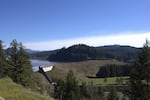
Dorena Lake, as seen on Feb. 27, 2026, is one of the more full USACE reservoirs in the Willamette River Basin.
Rebecca Hansen-White / KLCC
Staff at the U.S. Army Corps of Engineers are trying to manage their 13 reservoirs in the Willamette River Valley basin after a historically dry winter and spring.
USACE said this is the sixth-driest year in the valley since 1980, and reservoirs are less than 48% full.
“When there’s abundant water, the decisions are easy, but when there’s very little water, the decisions are sort of set in stone,” Deputy Operations Project Manager Dustin Bengtson said during a Thursday public meeting. “In a year like this, the tradeoffs really aren’t there in many cases, and we’re simply trying to manage or minimize impacts in the best way that we can.”
Bengston said the primary job of the reservoir system is to ensure that the millions of people who live in the Willamette River Valley are safe from flooding, followed by managing streams so they remain in a beneficial state for wildlife.
After that come benefits such as water quality and storage, hydropower and providing recreation sites.
“There is a lot of storage below our minimum conservation pool, so there’s still a lot of water,” Salina Hart, USACE chief of the Reservoir Regulation and Water Quality section, said during the meeting. “I know that fire crews do a lot of dipping and get water from our reservoirs. I don’t see any hindrance in being able to support wildfire suppression with our storage.”
Hart did mention that some recreation sites such as boat docks may close for the season earlier than they normally would.
Zac Ziegler is a reporter with KLCC. This story comes to you from the Northwest News Network, a collaboration between public media organizations in Oregon and Washington.
It is part of OPB’s broader effort to ensure that everyone in our region has access to quality journalism that informs, entertains and enriches their lives. To learn more, visit our journalism partnerships page.
