
In a unanimous vote Monday, OHSU’s board of directors approved the outline of a strategic plan to gradually shrink its colony of 4,500 research monkeys.
The Oregon National Primate Research Center is housed on OHSU’s west campus. It’s been home to about 5% of the total population of research primates in the United States.
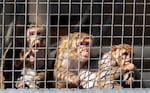
FILE - Monkeys in the sheltered housing units at OHSU’s Oregon National Primate Research Center in Beaverton, Ore., April 17, 2025.
Kristyna Wentz-Graff / OPB
Under the board’s strategic plan, OHSU would rename the primate center and evolve its mission away from science centered on using primates to model human diseases and towards the validation and exploration of new methods, like human cell-based models and computational science.
The center would also no longer commit to breeding and supplying primates for other federally funded research and may seek to withdraw from the consortium of seven national primate research centers.
The OHSU board’s decision followed six months of closed-door talks with the National Institutes of Health over whether the center could be converted wholesale into a primate sanctuary. Those talks ended without any clear source of funding to operate a sanctuary, which led OHSU to turn in another direction.
According to a brief presentation from OHSU’s negotiating team, the sanctuary option would require 17 to 40 years of ongoing funding, which would need to be secured from Congress. After discussing that prospect with Oregon’s congressional delegation, they concluded that it was too uncertain to proceed.
OHSU president Shereef Elnahal, who helped lead the talks, has refrained from commenting publicly on the primate center while those discussions were underway. He spoke at length about his decision-making during Monday’s board meeting and at a press conference immediately following it.
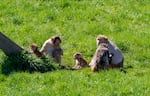
FILE - Japanese macaques at OHSU’s Oregon National Primate Research Center in Beaverton, Ore., April 17, 2025.
Kristyna Wentz-Graff / OPB
“Ultimately, the costs to run the center do not disappear when the science stops, and that is the major reason that ultimately a sanctuary was not possible,” Elnahal said at the outset of Monday’s meeting.
Elnahal said the primate center still faces the spectre of involuntary closure by the Oregon Legislature, which approved a budget note last session that temporarily barred any state funding for the facility.
Reducing the size of the primate colony and shifting the focus of its scientific mission, Elnahal said, is the best way to make the research financially self-sustaining in the long term.
The board set no specific target or timelines for reducing the size of the primate colony.
The plan is to deputize a team of scientists to assess how many primates are necessary to continue a slimmed down version of the center’s research mission — and to support new work validating alternatives to animal research.
Scientists at the primate center have been using so-called “New Approach Methods” to reduce their reliance on primates for the past decade and proposed expanding that work last fall, Elnahal said.
“Knowing whether new models may actually predict what occurs in a living system is a scientific problem,” he said. “Solving it requires exactly that comparative expertise, all of the methodologies that this center has spent decades building.”
In the short term, OHSU plans to continue scientific research at the primate center that has funding or is awaiting confirmation of funding. In the future, the resolution also calls for OHSU to continue biomedical research in primates that is unique and cannot be done elsewhere.
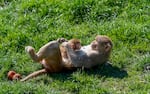
FILE - Japanese macaques at OHSU’s Oregon National Primate Research Center in Beaverton, Ore., April 17, 2025.
Kristyna Wentz-Graff / OPB
Skip Bohm, director of the ONPRC, said he was encouraged by the spirit of compromise behind the changes, and the board’s commitment to invest in new approaches.
At the same time, he asked the board to proceed cautiously with any plan to withdraw from the larger primate research consortium.
“These centers support research that is vital to public health preparedness and medical innovation, they also contribute to our national security,” he said.
Several animal welfare advocates also came to testify, saying they supported the resolution but urged OHSU to go further.
Adrian Miller, who identified herself as a graduate nursing student at OHSU, said she did not want her tuition payments used in support of invasive primate research that conflicts with her ethical values.
“Human research participants are afforded the right to make an informed decision about whether to accept the risks of research. Non-human primates are not allowed to make that choice,” she said.
At the press conference following the meeting, Elnahal said OHSU is still working with the NIH to clarify whether any existing federal grants could be used to support the cost of retiring monkeys from research.
OHSU, he said, will track that policy as it looks to shrink its primate colony, to see whether there’s funding available to move some animals to sanctuaries or other settings.
According to Elnahal, talks with the NIH revealed that paying to keep retired monkeys on the primate center’s campus would be significantly more expensive than sending them to a sanctuary.
“We want to do the most cost-effective thing with taxpayer money. The unit cost by these sanctuaries are much lower than the cost here,” he said.
