
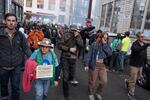
Protesters try to escape the area and get tear gas out of their eyes and lungs after federal immigration agents deployed the chemical munition on a crowd of more than a thousand demonstrators, many of whom were with local unions and included elderly people and children, in the blocks surrounding the U.S. Immigration and Customs Enforcement facility in Portland, Ore., on Jan. 31, 2026.
Eli Imadali / OPB
A federal appeals court late Wednesday temporarily blocked two separate rulings drastically limiting when federal officers can use crowd control weapons outside the Immigration and Customs Enforcement building in Portland.
In a 2-1 decision, a three-judge panel with the Ninth Circuit Court of Appeals granted the Trump administration’s emergency requests to pause two separate, preliminary injunctions issued by district court judges in Oregon that went into effect earlier this month.
In doing so, the appeals court appears to be fast tracking and consolidating two cases whose legal scaffoldings rely on drastically different areas of the Constitution, yet share the same result: The orders regulate the federal government’s response outside the Portland ICE facility.
One case was brought by demonstrators who said they’d been subjected to excessive force by federal officers at the protests. The other lawsuit was filed by the tenants who reside in an apartment complex nearby the ICE facility, who argued the regular use of chemical munitions violated their constitutional rights. U.S. District Court Judge Michael Simon oversaw the case from demonstrators, while U.S. District Court Judge Amy Baggio oversaw the case involving tenants.
In both cases, the federal judges in Oregon held evidentiary hearings that spanned days and resembled miniature trials where witnesses offered testimony and were cross-examined under oath.
And in both cases, the judges issued injunctions this month that limited when officers with the Department of Homeland Security and other federal agencies can use crowd control weapons, such as tear gas and pepper balls.
The appeals court’s temporary block on crowd control tactics comes just days before the third “No Kings” rally is scheduled to take place. Several demonstrations are planned across the country, including in Portland.
Federal officers have used force during protests this year, but not since Simon and Baggio’s orders. Testimony in Simon’s case included multiple examples of federal agents’ conduct during previous No Kings rallies. The preliminary injunctions still allow federal officers to use crowd control devices so long as there’s a specific and imminent threat of physical harm to officers or another person.
The 9th Circuit panel also issued an expedited briefing schedule and agreed to hear oral arguments via Zoom on April 7, 2026, at 10 a.m. Pacific Standard Time. But the 9th Circuit’s decision to grant the Trump administration’s emergency stay as the case plays out was split.
“The government has not demonstrated that an administrative stay is warranted,” appeals court judge Ana de Alba, who was nominated by President Joe Biden in 2023, wrote in a four-sentence dissent. “Nor does the government show a sufficient exigency to justify changing the status quo.”
Appeals court judges Kenneth Kiyul Lee and Eric C. Tung were in favor of the federal government’s request. Lee was nominated to the 9th Circuit by President Donald Trump in 2019, Tung by Trump last year.
“An administrative stay is intended to ‘minimize harm while an appellate court deliberates’ and lasts ‘no longer than necessary to make an intelligent decision on the motion for stay pending appeal,’” Lee and Tung wrote. “An administrative stay ‘does not constitute in any way a decision as to the merits of the motion for a stay pending appeal.’”
Still, the stay marked a setback for those who brought the lawsuits in the first place.
“We are disappointed that the appeals court paused the injunction before hearing from our clients,” said Kelly Simon, legal director of the ACLU of Oregon, which led a coalition of attorneys representing the protesters. “We look forward to discussing the law and facts with the court, and intend to present our side promptly.”
The Justice Department made clear in both cases that it would appeal if the rulings did not go their way.
Last week, the federal government did, arguing the “sweeping” injunction “effectively prohibits the use of common crowd-control devices to disperse violent or disruptive crowds.”
Judge Simon referenced the idea of a Justice Department appeal when he made his initial decision on the injunction. He encouraged judges on that higher court to look at the video evidence in the case showing DHS officers using force on nonviolent protesters.
“The videos are both unambiguous and disturbing,” Simon wrote.
