
Protesters navigate a cloud of tear gas outside of the U.S. Immigrations and Customs Enforcement building, where federal officers deployed tear gas, flash-bangs, and pepper balls in Portland, Ore., Oct. 18, 2025. Officers continued using a barrage of chemical agents and munitions on the nonviolent protesters after the driveway was cleared.
Eli Imadali / OPB
A lawsuit over chemical munitions seeping into residences at a low-income apartment complex across from the U.S. Immigration and Customs Enforcement facility in Portland went before a federal judge Friday.
The neighbors and property management group of Gray’s Landing, which sits kitty-corner from the embattled immigration facility, aim to limit federal officers from clouding the neighborhood with stinging gas and other munitions.
The crux of their argument: The chemicals are not only infiltrating homes, but wreaking havoc on their bodies and lives. They’ve described in court filings times they’ve slept with gas masks and sealed gaps in doors and windows with wet towels.
U.S. Department of Justice attorneys counter that they need the ability to deploy chemical munitions in order to manage the crowds. Protests have persisted, sometimes in large numbers but often in small, persistent crowds, since late spring 2025. Oral arguments in the case are set for next week.
A separate lawsuit has already led a federal judge to limit crowd control munitions use temporarily. On Feb. 3, U.S. District Court Judge Michael Simon issued a temporary, two-week ban on chemical munitions, except under limited circumstances.
Attorneys representing Gray’s Landing tenants in the suit – which names U.S. Department of Homeland Security Secretary Kristi Noem – want a block on their use that lasts at least until their case is settled.

Thick clouds of tear gas, deployed by federal immigration officers, fill the air hundreds of protesters, including children and elderly people, demonstrate outside of the ICE building in Portland, Jan. 31, 2026.
Eli Imadali / OPB
In court filings, the tenants and REACH Community Development, the nonprofit that manages the building, wrote that federal law enforcement has been overly aggressive with firing pepper balls and deploying chemical gas.
Although protests and the use of munitions dwindled in November and December, they returned in January following the shooting deaths of two U.S. citizens in Minneapolis by federal law enforcement.
Protests against the Trump administration in January and early February resulted in hundreds of protesters being gassed outside the building, including elderly people and children. Images of adults flushing irritants out of children’s eyes with water hit social media.
As OPB previously reported, federal officers fired a projectile on Jan. 31 that damaged a Gray’s Landing tenant’s window. The gas that entered the apartment that day led a Yemen-born woman and her mother both to vomit.
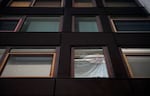
A window broken in a Gray’s Landing apartment as a result of a crowd control munition from the U.S. Immigration and Customs Enforcement facility which is across the street, in Portland, Ore., on Jan. 31, 2026. Federal officers used crowd control munitions, which included chemical and projectile munitions that evening.
Eli Imadali / OPB
The plaintiffs’ attorneys wrote that it’s only a matter of when – not if – the apartment complex will be enveloped in chemical clouds.
“Defendants used massive amounts of tear gas, sometimes multiple times per day, on five different days in an eight-day period,” attorney Dan Jacobson wrote Thursday of the recent protests.
Tenants described a number of different afflictions as a result, including stinging in their eyes and noses. Some have said they’ve been hit with pepper balls by federal law enforcement outside their home. One tenant claimed in filings that her cortisol levels have been so high from the munitions that a doctor has recommended she have surgery to remove an adrenal gland.
Their specific legal argument is that their constitutional rights under the Fourth and Fifth amendments are being violated. They say the chemicals amount to the government intruding into their homes while the tenants, at the same time, are unable to leave.
Justice Department attorneys have called those arguments baseless. While they acknowledge the munitions don’t discriminate, they said federal officers are empowered to use them when crowds spin out of control.
“The Constitution does not compel law enforcement officers to rely solely on face-to-face physical confrontation with unlawful crowds simply because airborne irritants might drift to nearby buildings,” wrote attorneys Samuel Holt and Kathleen Jacobs.
