
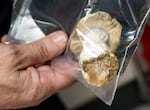
FILE - A psilocybin mushroom is ready for testing at Rose City Laboratories, March 17, 2023.
Kristyna Wentz-Graff / OPB
Oregon became the first in the nation to legalize psychedelic therapy through psilocybin back in 2020.
What soon followed were bans in various jurisdictions, large costs for individuals seeking treatment and other barriers to access. Now, new reporting from the New York Times found that a third of Psilocybin service centers have closed and other states have also begun offering this therapy, including Colorado and New Mexico.
Andrew Jacobs is a health and science reporter for the NYT. He joins us to share more on where things stand in Oregon’s program and what other states have learned from the state’s first-in-the-nation rollout.
Note: The following transcript was transcribed digitally and validated for accuracy, readability and formatting by an OPB volunteer.
Dave Miller: This is Think Out Loud on OPB. I’m Dave Miller. In 2020, Oregon voters approved a ballot measure to legalize the supervised use of psilocybin. Oregon was the first state to do so, and the rollout has been rocky with high costs for providers and clients. A third of psilocybin service centers have closed. Recently, Colorado and New Mexico have started up their own programs with Oregon’s hiccups as a kind of cautionary tale. Andrew Jacobs is a health and science reporter for The New York Times. He wrote about all of this recently, and he joins us now. It’s great to have you on the show.
Andrew Jacobs: Great to be here. Thanks for having me.
Miller: Can you remind us the basics of what Oregon voters approved back in 2020?
Jacobs: Oregon’s model basically allows for facilitated psilocybin experiences. It requires a special license to open such a facility, and those who work there have to also be licensed. It does not allow for personal use, doesn’t allow for people to take it home, so it’s quite limited in its scope.
Miller: As I mentioned, and as you reported, a third of licensed centers have closed. What are the reasons you heard for that?
Jacobs: It’s basically about economics. It’s cost, like I mentioned, the licensing fees are about $10,000 just to, annually, just to open a center, and that doesn’t include insurance, high rents, other costs that are all sort of tied to sort of the unique nature of both psilocybin therapy – first in the nation – but also by some of the legal issues because psilocybin is illegal at the federal level, which complicates things like banking and insurance.
Insurance rates are about three times higher than it is for other medical and health related businesses. Basically these operators and owners are shutting down because they can’t afford to operate. Combined with that, the high cost of the therapy has meant fewer clients than expected. So revenue is not what they expected and that’s why they’re shutting down.
Miller: You pointed to a worrisome feedback cycle in your reporting, so the many licensed centers closing because of the high cost of doing business, as you just mentioned, but now the ones that have survived may actually have to pay more going forward. Why is that?
Jacobs: Yeah, that’s the result of the legislation that established this program. It has to be entirely self-funded. The Oregon Health Authority points out that their hands are tied. That means, with no other support from the state, those fees have to pay for the whole administering of the program, which is admittedly fairly complicated. Folks I spoke to said that they wish they could do otherwise, but they will likely have to raise fees in the coming year because so many of those operators have dropped out.
Miller: A lot of this is not a surprise to people who’ve been paying attention to this in Oregon for years now, even before the passage of the ballot measure and then during the rulemaking. There were a lot of warnings about affordability and access. What did you hear from state regulators about the current situation?
Jacobs: I think they are sympathetic and their hands are tied. I think in the end it’s gonna have to come down to elected officials may have to address this through new legislation. The costs, again, are tied to the fees and some of the other rules like you need to have two staff members on site for a session, that raises costs. The other factor is there are a lot of sort of zoning related rules about where you can and can’t open. A center can’t be 1000 feet from a school. I think 25 of Oregon’s 36 counties have opted out of the program, so that limits again where these clinics can operate. Some of these issues need to be kind of worked out by elected officials, and I’m not sure whether that’s on anyone’s plate at the moment, but I think a lot of the operators are sort of agitating to get some attention to that.
Miller: The economics is one side. It’s an important side, whether the costs of doing business or the or the costs for would-be legal clients. But how much data is there about what these sessions have actually meant for clients who can afford it, who are taking part in these supervised psychedelic sessions?
Jacobs: The data is kind of a mixed bag because early on there was not a lot of mandatory reporting. I think that has changed recently, so there is more data coming in. The data that we do have on adverse events is pretty good, and there’s been very few, about two dozen reported adverse events associated with psilocybin, and they’ve been fairly minor. Oregon Health Authority said that none of them have resulted in hospitalization. And they’re largely people who took the psilocybin and maybe were agitated, anxious, wanted to leave, and you’re not allowed to do that. You have to stay at the center while you’re undergoing this therapy for up to six hours, and so that’s when they would call 911, because you can’t leave.
That seems to be the most prevalent adverse effect. I think that’s pretty significant because there’s a lot of fear out there and a lot of what governs these restrictions, and certainly why counties opted out, is because there’s a lot of stigma and fear associated with this drug, dating from the war on drugs in the ‘70s. People just think it’s a scary drug, and it turns out the effects are not as worrisome or dangerous as we might have thought.
But I think, anecdotally, very positive kind of reactions or results from people who’ve done it, everyone I spoke to who’s in this field says that it’s remarkable how many people have had positive experiences. Not a silver bullet, not a magic pill, as it were. It requires a lot of work, but there’s all, by and large, very positive impacts on the patients who’ve done it.
Miller: Right, and just to put that in perspective, I actually don’t have the numbers from your article in front of me, but you said something like two dozen adverse experiences. That’s out of more than 10,000 clients who’ve taken part. So the denominator is a really important piece there.
Jacobs: Absolutely, yeah.
Miller: You had a great line from a licensed operator in Bend who said that psilocybin therapy, statistically speaking, is safer than golfing, a memorable line. I want to turn back to the other piece you’ve been talking about, which is that with a lot of these clinics closing, and a lot of licensed and unlicensed facilitators in the state, there is a seemingly thriving underground market. How much can you say about that? I mean, given that it’s underground, what can you say about it?
Jacobs: I really can’t say much in terms of how prevalent it is. I know it is fairly common because you have hundreds of people who’ve gone through the licensing process as facilitators and can’t find work or can’t afford whatever fees are required to set up, so they are doing it on the side. I don’t think there’s any data out there, but the people I spoke to, it’s not uncommon, especially for folks who are local, for clients and patients who are local. I think if you’re traveling from another state, and what’s interesting is I think it’s more than half, maybe 60% of the patients who are doing the licensed psilocybin, are from out of state.
I think someone like that is probably unlikely to go to the underground, but I think if you’re local, and you’ll know people, you’ll have a friend of a friend who knows someone, I think it’s a much easier route. And given what we’re seeing in terms of safety, I think people probably make the calculation that it’s worth saving $3,000 or whatever, the high-end of this therapy is $3,000 for a session, they make the calculation that’s worth taking that risk.
Miller: OK, so as we were talking about, Oregon is the first state to allow psilocybin therapy, but other states have followed. What is Colorado doing and to what extent are they tailoring their program based on what’s worked and what has not worked in Oregon?
Jacobs: Colorado officials, they told me they have a monthly call with folks in Oregon, so that’s interesting, and to go over what works and what doesn’t work. But their program is, I would say, less restrictive, or Colorado, when they passed their ballot measure, they also decriminalized psilocybin, so that opened up the door for personal use. It’s legal to grow it, to trade it with your friends.
They also allowed for use at home, which is helpful for those in palliative care, which is a big component of the patients who want to access this therapy, for end of life anxiety, people with cancer. People who have other serious illnesses often can’t travel, maybe they can’t get out of bed, they can’t go to a psilocybin center. So that opens the door to more of that practice.
I think microdosing is another big one, increasingly popular across the country. Microdosing psilocybin and LSD, that’s not easy to do in Oregon. You have to go through a lot of the same paperwork, a patient, that is, you have to spend a lot of time at the center to microdose before and after. Not such barricades in Colorado, makes it much easier to do microdosing. So those are kind of the big differences. Licensing fees in Colorado are also about 20% less expensive. So all in all I think it’s just a much less friction in that program to get a business going.
Miller: And what about New Mexico?
Jacobs: New Mexico is brand new in that it was just approved by the state legislature last year. First clinics should be opening up this year. That’s actually in some ways more strict. It’s a medical model in that you have to have a diagnosis to access it. It’s PTSD treatment resistant depression and of light anxiety. I should note that in Colorado and Oregon, you don’t need any diagnosis. Anyone can go and access this therapy. New Mexico decided to medicalize their program, and we’ll see how that pans out.
The other thing I forgot to mention, in Colorado there’s a dual licensure allowance, which means that you can be a regular therapist and also do psilocybin therapy. Right now in Oregon, it’s really limited to trained facilitators who have that special license. That’s meant to change in this year, but that’s another little point to note.
Miller: Before we say goodbye, I noted that your bio says that you focus on how healthcare policy, politics, and corporate interests affect people’s lives. With that in mind, can I ask you to share the story of Alyssa Segong from Wisconsin who came to Oregon?
Jacobs: So Alyssa, she’s a former public media executive who was diagnosed with metastatic breast cancer three years ago, and beautiful story and an amazing woman and just how her own journey dealing with mortality. And she did, her session really… And I spoke to her just after she’d come back and she really, she said the the therapy had really given a sense of safety in her body, the time she felt betrayed by her own body, and sort of given her this optimism, not about beating cancer, but about rather kind of living purposefully with the time she had left and giving her a real sort of renewed connection to nature, which a lot of people who do this therapy talk about. Giving you a sense of context and perspective on your mortality and life. She was a really inspiring person to talk to.
Miller: Andrew, thanks very much.
Jacobs: Thanks for having me.
Miller: Andrew Jacobs, a health and science reporter for The New York Times.
“Think Out Loud®” broadcasts live at noon every day and rebroadcasts at 8 p.m.
If you’d like to comment on any of the topics in this show or suggest a topic of your own, please get in touch with us on Facebook, send an email to thinkoutloud@opb.org, or you can leave a voicemail for us at 503-293-1983.
